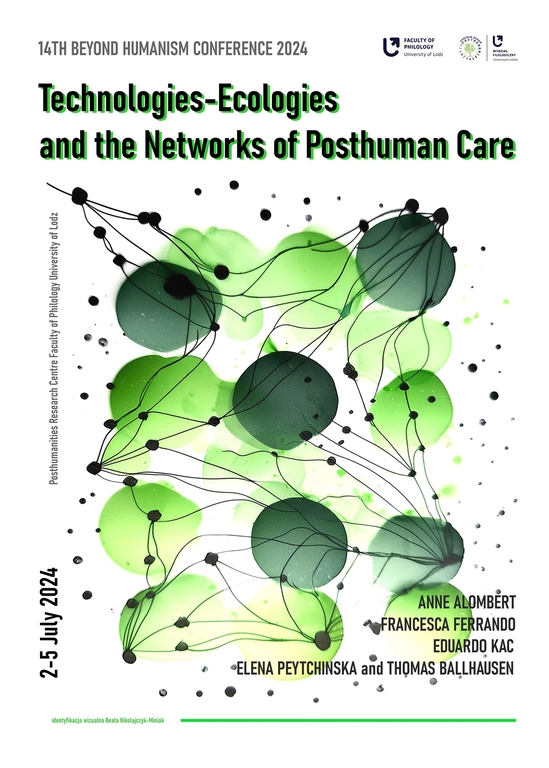
14TH beyond humanism conference 2024 technologies-ecologies and the networks of posthuman care
Posthumanities Research Centre Faculty of Philology
University of Lodz
2-5 July 2024
CONFIRMED KEYNOTES:
ANNE ALOMBERT
llcp.univ-paris8.fr/anne-alombert-mcf
FABIENNE BRUGÈRE
philosophie.univ-paris8.fr/fabienne-brugere
EDUARDO KAC
www.ekac.org
RYSZARD KLUSZCZYŃSKI
www.uni.lodz.pl/pracownicy/ryszard-kluszczynski
The images and narratives of crises have dominated the socio-cultural sphere over the last couple of years, often anaesthetizing our senses and creating a further sense of impasse. As Bernard Stiegler asserts, these perplexing conditions require finding out how “to think and care otherwise, that is, to change the very meaning of thinking” (2018: 237). For the philosopher, to think means “to take care, to care for, which is also to say, to act, to do, to make – (the) différance: it would always be to think the wound” (2018: 215). Thus, thinking with care implies taking actions to heighten our responsiveness to the challenges the Anthropocene poses. When discussing Heidegger, Yuk Hui observes that “being-in-the-world is nothing but the question of care (Sorge), or temporality” (2016: 227). Hui observes that, for Heidegger, Sorge constituted a “primordial form of existence” (2016: 246). Derived from Besorgen and linked with Fürsorge, care renders ways of being in the world and interacting with others (Hui, 2016: 246, 274). Referring to Haraway’s claim (2016: 4) that “we become-with each other or not all,” Amelia deFalco in Curious Kin in Fictions of Posthuman Care argues that “[i]f relating produces being, who and what we relate to, care for, and are cared for by has profound consequences” (2023: 5). What is more, deFalco rightly indicates how the narratives of exclusion are interconnected with being regarded as care-capable and care-worthy (2023: 5). Likewise, Maria Puig de la Bellacasa points out that processes of thinking and knowing, which are inherently intertwined with a multitude of relations, encompass care. In her view, care is thus relational (2012: 198), as acts of care compel us to nurture the relational character of our more-than-human lives. The acknowledgement of our entangled, differential, interconnected lives activates a collaborative spirit of compassion and care to produce ethical actions and practices to shape our posthuman futures. Rosi Braidotiti, in her latest monograph, Posthuman Feminism, urges us that “[w]e need to work together to reconstruct our shared understanding of possible posthuman futures that will include solidarity, care and compassion” (2022: 8). In her 2018 Nobel Lecture, Olga Tokarczuk writes: “Tenderness is spontaneous and disinterested; it goes far beyond empathetic fellow feeling…. It is a way of looking that shows the world as being alive, living, interconnected, cooperating with, and codependent on itself.” For her, “tenderness is deep, emotional concern about another being,” “human and beyond human,” in general, it is an attitude, action, physical sensation realised, among others, via touch, for instance, in relation to technology (Malinowska 2022: 44). Tenderness permeates all the boundaries of digital and biological, living and non-organic, beyond time and human. It is a click that animates pixels and atoms of water that run through more-than-human beings. In other words, the capacity for care lies in more-than-human milieux if we wish to develop novel, inclusive ways of thinking and writing. It induces the renewal of current forms of planetary co-existence responsible for reproducing enduring patterns of humaninduced inequalities and global power imbalances.
In Art and Cosmotechnics, Hui recalls Smith’s claim (2019) that machines entangled in their actions with the world exhibit a form of care by their attempt to “engage and modify it” (2021: 241). On a simple level, care tends to be discussed more in terms of providing than exhibiting. If we assume that care is the category whose importance is recognised in both humanities and sciences, maybe we should think of care and AI beyond care robots, in other words, beyond what machines can do for humans? To what extent can the category of care apply to developing neural networks? The conference wishes to explore how care is implicated in trans-, meta-, post- human philosophies. Sorgner explains that “metahumanism strives to mediate among the most diverse philosophical discourses in the interest of letting the appropriate meaning of relationality, perspective, and radical plurality emerge” (2021: 41). Bearing the “radical plurality” in mind, the conference seeks to study how these philosophies approach diverse forms of organic and non-organic embodiments, raising new ethical, legal and biotechnological dilemmas.
The conference is devoted to the reconceptualization of the posthuman condition brought about by the care turn. We invite you to consider how to invent/create networks of care that could bring hopeful scenarios of endurance and reconstruction of the planetary mayhem.
The papers should address the general theme of the conference. Possible topics may include, but are not limited to:
- Posthuman collective networks of care;
- Posthuman care and ageing;
- Posthuman care and climate crisis,
- Posthuman care and technologies of intimacy;
- Posthuman care and feminisms;
- Posthuman care and ethics;
- Posthuman care and digital practices;
- Posthuman care and the Anthropocene;
- Posthuman care and the social media;
- Posthuman care and New Materialisms;
- Posthuman care and NGOs and volunteering;
- Posthuman care and LGBTQ+ communities;
- Posthuman care and disability studies;
- Posthuman care and more-than-human knowledge production;
- Posthuman care and Indigenous studies;
- Posthuman care and non-western knowledge production;
- Posthuman care and performativity;
- Posthuman care and aesthetics;
- Posthuman care and artistic practices;
- Posthuman care and tender narratives and poetics;
- Posthuman care and technoscientific experimentation;
- Posthuman care and multiple forms of fabulation;
- Posthuman care and speculative genre voices;
Submission guidelines
We invite paper proposals including a title, an abstract of 350 words, name and affiliation of the author, as well as a short bio with contact information. Applications together with a short bio-bibliographical note should be submitted in English and in PDF format on easychair.org before the 31st of March easychair.org/conferences/
Deadlines
Abstracts should be received by the 31st of March 2024. Acceptance notifications will be sent out by mid-April 2024. All those accepted will receive information on the venue(s), local attractions, accommodations, restaurants, and planned events for participants.
Presentations should be no longer than 20 minutes. Each presenter will be given 10 additional minutes for questions and discussions with the audience.
Conference fees
- 100 euros (early bird until the end of April)
- 140 euros (a regular fee)
- 80 euros (PhD students)
Conference email
beyondhumanism14@gmail.com
ORGANISING COMMITTEE:
Stefan Sorgner (John Cabot University, Rome) Evi Sampanikou (University of the Aegean, Department of Cultural Technology and Communication) Sangkyu Shin (Ewha Womans University, Ewha Institute for the Humanities) Aranaud Regnauld (University of Paris 8, TransCrit) Jan Stasien ko (DSW University of Lower Silesia, The Research Centre for Games and Animation) Tomasz Dobrogoszcz (University of Lodz, Posthumanities Research Centre. hosting the event) Katarzyna Ostalska (University of Lodz, Posthumanities Research Centre. hosting the event) Justyna Stępien (University of Lodz, Posthumanities Research Centre. hosting the event) Agnieszka Jagła (University of Lodz, Posthumanities Research Centre. hosting the event)