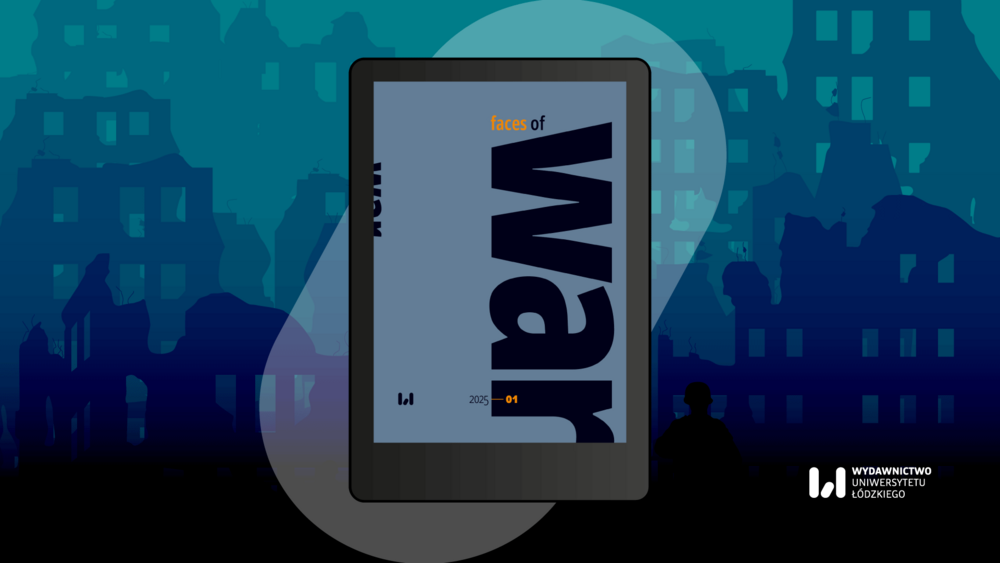
FACES of WAR is a peer‑reviewed, interdisciplinary journal devoted to the study of armed conflicts from antiquity to the present day. As an English‑language, open‑access biannual published by the University of Lodz Press and affiliated with the Faculty of Philosophy and History, it provides a platform for scholars from history, international relations, law, security studies, cultural studies, architecture, and urban planning. The journal brings together original research that broadens our understanding of war, its mechanisms, and its human consequences.
The newest issue features a rich collection of articles spanning medieval Italy, early modern economic history, 20th‑century totalitarian violence, wartime cultural transformations, and contemporary debates on memory and methodology. Together, they highlight the journal’s commitment to diverse perspectives and rigorous scholarship.
The following articles are included in the new issue of FACES of WAR:
After One Disaster Comes Another? Extraordinary Events and Their Lessons in the Croniche di Lucca
Zoltán Szolnoki
In the Croniche di Lucca, which covers the period of Lucca’s history from 1168 to 1424, we read about many natural disasters. We can read in detail about the lean years of 1181, 1284, 1330, 1348–1350, and 1400, and the plagues that followed, as well as the great windstorm of 1398. According to the descriptions, epidemics were almost always followed by wars or urban riots. The author of the historical work, Giovanni Sercambi (1348–1424), was not only a writer but also an active politician. He wrote down a significant part of the events he witnessed with the aim of teaching. He tried to formulate correlations both in the case of party fights and riots affecting the life of the city, as well as in the case of the aforementioned disasters. He stated that bad things are usually followed by more bad things. He usually attached social or moral consequences to the individual events, which are outstanding sources of the history of the mentality of that period. He stated that the moral implications of the disunity experienced in urban politics are famine and epidemics, which in turn can lead to riots and uprisings. The question is, what were the additional consequences of the extraordinary events for the inhabitants of the city at the time? In my presentation, I will examine the relevant entries of the chronicle, analyse the social and moral lessons written down by Sercambi, compare the chapters of the Lucca source with the relevant notes of other contemporary Tuscan historical works, and draw conclusions about the unique features.
Weapons and Wealth: Economic Effects of the Lucca’s War in Florentine Arms and Armour Production (1429–1433)
Simone Picchianti
In traditional historiography, the wartime context is often judged to have had a uniformly negative impact on medieval economies. While this assessment holds in many respects, it has overlooked the specific sector of arms and armour production and trade, owing to a longstanding lack of focused study. This historiographical gap has thereby distorted our understanding of the period’s economic reality. The present research, grounded in the payment mandates preserved by the Dieci di Balìa, the Florentine war office, during the War of Lucca (1429–1433), seeks to fill that void by offering a concrete appraisal of the arms and armour economy. By examining every recorded expenditure on artillery and firearms with their accompanying gunpowder and bullets, on crossbows and the accessories required for their operation, on polearms, and on defensive armour, the study harnesses the richness and precision of archival evidence to reconstruct quantities purchased, total outlays, production locations and the identities of individual suppliers. Repeated spikes in spending correspond closely with the most intense phases of the campaign, demonstrating that demand for weaponry generated a marked, localised surge in economic activity. Notably, rural hamlets such as Montefioralle and La Trappola emerged as specialised centres for crossbow bolt manufacture, while a Florentine apothecary came to dominate the gunpowder supply. Contrary to the prevailing view that war uniformly depressed Florentine economic life, the conflict with Lucca functioned as a powerful stimulus for sectoral growth, furnishing blacksmiths, carpenters, barrel makers and arms dealers with exceptional earning opportunities. By mapping the supply chains behind every cannon, bolt and spear and by correlating expenditure peaks with the military chronology, this study demonstrates that late-medieval warfare could serve as a positive-sum catalyst, anticipating the organised armaments industries of later centuries and calling for a substantial revision of traditional narratives about the economic impact of war.
The Rise of Northern Unionism’s Influence on the Political Scene of Great Britain Against the Backdrop of Belfast’s Social and Economic Transformations During the Great War
Antonina Pawłowska
This article examines the situation in Belfast during the First World War, considering its role as the political and economic centre of the north of Ireland. It explores whether the global conflict contributed to the city’s development or led to its stagnation, focusing on three key aspects: economic, social, and political. The economic analysis particularly highlights the state of the shipbuilding industry. The study of social conditions reveals the economic, religious, and cultural sources of divisions among Belfast’s residents and shipyard workers. Meanwhile, the discussion of the political aspect traces key transformations within the Irish unionist movement, mainly its faction closely linked to Ulster and Belfast. The article aims to outline the situation in north of Ireland during the Great War to explain the causes of the growing social divisions in the interwar period, which ultimately led to the establishment of an administratively separate Northern Ireland.
The Fate of the Brazilian Collection of the State Zoological Museum in Warsaw Before and During the Second World War (1939–1945)
Dominika Mierzwa-Szymkowiak, Higor Gabriel Borecki, Fernando Costa Straube, Mário José Gondek, Arkadiusz Cegliński
Before the Second World War, the State Zoological Museum in Warsaw was a dynamically functioning research institution, characterised by its rapidly growing collections of contemporary animals for scientific, educational and exhibition purposes. The specimens were mainly collected during expeditions organised by the museum’s staff. One of the explorers was Tadeusz Chrostowski (1878–1923), an ornithologist and head of the Neotropical Birds Department of the Museum. The naturalist organised three expeditions to Brazil in 1910–1911, 1913–1915 and 1921–1923. He explored areas of the state of Paraná that were considered the least explored. Chrostowski’s last journey, known as the Polish Zoological Expedition, received the most attention in scientific and social circles. It was the leading overseas scientific expedition organised by the newly revived Polish state. In addition to Chrostowski, the research team included the entomologist Tadeusz Jaczewski (1899–1974) and the taxidermist Stanisław Borecki (1888–1968). The team aimed to study the fauna of southern and central Paraná, specifically in areas with araucaria humid forests inhabited by Polish colonies, subtropical forests, and along the rivers Ivaí, Paraná and Iguaçu. A collection of over 22,000 zoological specimens was one of the outcomes of the fieldwork. The material included many species of birds first found in the Paraná. The collection was taken to Warsaw in 1924 and was available to researchers in the museum until 1939. The Second World War was a tragic event in the history of the institution. Not only did it interrupt scientific and research activities, but it also contributed to the loss of part of the collection. Among the museum’s war losses were more than 2 million animal specimens, including more than 20,000 of Chrostowski’s specimens. The collections were destroyed, confiscated and exported and many were dispersed. Research into the history of Chrostowski’s collection aims to reconstruct and describe it, as well as to spread knowledge of the wartime losses suffered by the State Zoological Museum during the Second World War.
Incorporation of Andriy Melnyk’s OUN into the Kharkiv Environment (1941–1943)
Helena Diakova, Daniil Topchiі
Today, studying the spread of OUN activities, particularly those of the OUN(m), in Eastern Ukraine during the German-Soviet War is particularly relevant. This paper aims to highlight the work of the OUN(m) in Kharkiv during the Nazi occupation. Analysing the available sources and publications, it can be stated that during the German-Soviet war, the OUN(m) took the opportunity to spread their ideology in the Eastern Ukrainian lands, creating their cells among the local population. The primary tasks of the OUN(m), who arrived in Kharkiv with the Germans as part of a Sonderkommando or propaganda groups, were to infiltrate the local administration, police, and cultural and educational institutions; propagate nationalist ideas about creating an independent Ukrainian state; and organise local cells. To do this, they used both legal and illegal methods. Bohdan Konyk, Yakiv Kravchuk, and Petro Sahaidachnyi were particularly prominent in Kharkiv. The peak of OUN(m) activity in the city was October–December 1941. This was due to their proximity to the Germans and the ability to conduct their work legally. During the Nazi Occupation, the ideological views of the OUN(m) in Kharkiv were transformed to adapt to a more moderate Eastern Ukrainian version of nationalism. Nevertheless, their ideas became known to the wider Kharkiv community, influencing the vision of Ukraine’s future among local nationalists.
Representation of the Nazi Crimes in Donbass in Soviet Documentary and Fictional Cinema (1943–1950)
Olena Tytarenko
Soviet documentary and fiction cinema of World War II and the first postwar years created several images related to Donbas. This region had played a significant role in Soviet socio-political discourse since prewar times. The article focuses on the peculiarities of the representation of Nazi crimes in Donbas. The author analyses the main fiction and documentary films that feature episodes of crimes committed during the German occupation, describes their historical context, and characterises the degree of influence these scenes had on the population. It is noted that the subject of Nazi crimes in Donbas first appears in the visual images of the destruction of industrial and social infrastructure caused by the Nazis. The issue of the murder of the population of the occupied territories is explored in documentaries related to the central site of mass crimes — the 4–4 bis mine in Stalino (today Donetsk). Fiction cinema dedicated to the topic of the wartime Donbas is represented by the films The Unconquered (Nepokorennyye), It Happened in Donbas (Eto bylo v Donbasse), The Young Guard (Molodaya gvardiya), and A Great Life (Bol’shaya zhizn’). The key focus is on the issues of the struggle against Nazism and post-war reconstruction. The films show the torture and murder of members of the anti-Nazi Resistance movement, including juveniles, the executions of Soviet prisoners of war, the deportation of civilians to Germany, and, for the first time in Soviet cinema, a scene of a mass execution of the Jewish population. Despite several historical inconsistencies, as the films were usually based on literary works, these films were very popular among the population that survived the occupation. Both abstract and concrete images of victims of the Nazi regime evoked allusions to their suffering caused by the war and occupation. The images of the wartime Donbas are still an important source for the perspective of reflecting the historical processes of the past and for studying the system of influence on the outlook and value coordinates of the population in different historical epochs.
Ukrainian Classical Music in the Public Sphere Amid the Russo-Ukrainian War: 2022–2023
Nataliia Kuleba
This article discusses the state of Ukrainian classical music during the first years of the full-scale Russian invasion, the understanding of which requires familiarity with the historical context and the rhetoric of post-colonial studies. The cultural confrontation between Ukraine and Russia reached its peak during this period, leading to a significant decline in the promotion and performance of Russian classical music both within Ukraine and internationally. Since 2022, a shift in the Ukrainian musical landscape—marked by the revitalisation of repertoire politics and an active process of derussification has been observed. This positive development is demonstrated in Ukraine’s opera houses and their ongoing repertory renewal: this includes Kateryna by Oleksandr Rodin (Odesa), Fearful Revenge by Ievhen Stankovych (Lviv), and Vyshyvanyi. The King of Ukraine by Alla Zahaikevych (Kharkiv). The Ukrainian opera Chornobyldorf by Roman Hryhoriv and Illia Razumetskyi is regarded as one of the best modern repertory operas. The staging of Genesis. Opera of Memory by the same authors in the Khanenko Museum (Kyiv, 2022) has become a new phenomenon in Ukrainian musical life. The Nova Opera group presented the Art of War opera by the young composer Serhii Vilka, based on a libretto by Myroslav Laiuk. Classical works by Ukrainian composers are also being reconceptualised: Lviv Opera presented an action version of Cossacks Beyond the Danube by Semen Hulak-Artemovskyi. Global interest in the works of Ukrainian classical music has increased; therefore, the online repository of works by local composers (the number of records on the Ukrainian Live Classic app platform rose from 500 to 1700, representing the creativity of more than 70 authors) has been developed. The renowned promoter of Ukrainian classical music is the Days of Ukrainian Music in Warsaw’ festival, which has been held since 1999 (founded by Roman Rewakowicz). The world tours of the Ukrainian Freedom Orchestra (initiated by the Metropolitan Opera and Polish National Opera) and the Kyiv Symphony Orchestra, whose programmes are based on Ukrainian music, occur within the framework of cultural diplomacy. In November 2022, during the United Kingdom–Ukraine Season of Culture, a festival of new and experimental music took place in Huddersfield with the participation of Ukrainian performers. The ‘Solidarity Project’ is an invitation from Ukrainian composers to collaborate with the Metropolitan Opera. However, there remains a lack of professional discussion regarding national classical music in the Ukrainian media landscape. Departments specialising in the post-colonial studies of Russian culture, in which Ukrainian culture has existed on the sidelines for a long time, are currently being established.
The Evolution of the Role of Mass Media in Wars – Media as a Tool, a Threat and a Side of the War
Katarzyna E. Derlatka
Released information can lead to the outbreak of war, such as ‘The Ems Telegram’. It can also cause changes in the actions of the ‘great and the small’ of this world, influence the perception of reality and lead to a reversal of events. The examples of the media’s involvement in the history of wars described in this article demonstrate its use by conflicting parties as an instrument of warfare. Furthermore, they also make it clear that the media can be a threat and even a war party. During war, it is necessary to control the media space, understand the role of the media, pay attention to their presence in war, their technological capabilities, and their power to influence audiences and developments. Skilful and planned use of the media for political and military purposes can influence the success of operations.
Overestimated Balance Sheet — the Astray of Research Without Archival Sources. In Response to Kazimierz Przeszowski
Hubert Kuberski
The polemic reviews the research of Kazimierz Przeszowski, which was intended as a balance sheet of previous estimates by Stanisław Płoski and Ewa Śliwińska, Adam Borkiewicz, Hanns von Krannhals, Maria Turlejska, Antoni Przygoński, Joanna Hanson, Maja Motyl and Stanisław Rutkowski, Piotr Gursztyn, Norbert Bączyk and Grzegorz Jasiński, as well as Hubert Kuberski. These estimates indicate that the number of victims of the Wola massacre ranged from 10,000 to 57,600 (even 65,000). This part can be considered a precise summary of previous studies. However, the subsequent section of the article is based on statistical research derived from postwar historians’ studies (lacking statistical data from 1938–1944), which does not allow for detailed research. The comparative analysis of mass executions in Rumbula near Riga, Babi Yar near Kyiv, and executions carried out during Operation ‘Ertnefest’ [sic! actually — Aktion ‘Erntefest’] in Distrikt Lublin is even more problematic, as the author proves that German forces in Wola were sufficient to exterminate even 65,000 people. Przeszowski demonstrated that the Wola district was estimated to have been inhabited by around 100,000 people in the summer of 1944, potential victims of mass executions. These finding, indicate the need for a new methodological approach and further archival research into the number of human losses in Wola in 1944, particularly concerning the analysis of documents preserved in the Bundesarchiv. This place provides an orientation to the number of German, Austrian and Eastern European exterminators during the two-day danse macabre in Northern County — commonly known as the Wola district.
Response to the Polemic Regarding the Review of Research on Population Losses in the Wola District During the Warsaw Uprising of 1944
Kazimierz Przeszowski
This response draws attention to the purpose of the original 2024 article, presents general remarks on the polemic text, and discusses the allegations concerning the review of research and the comparative study regarding: The number of victims of mass executions, the size of the German pacification forces, and the area and population of the Wola district. Finally, it addresses the relevance of the findings of the original article in light of the criticisms raised in the polemic.
We invite you to explore the full issue HERE.